The need for workplace investigations is not only strongly recommended but, in many cases, necessary to meet legal obligations and ensure procedural fairness. Conducting timely and appropriate investigations helps businesses address issues effectively, manage risk, and maintain a safe and compliant workplace environment.
Let's Get Started! Fill out your details and let our team assist
What are workplace investigations?
A workplace investigation is a structured process used to examine allegations of misconduct, complaints, or breaches of workplace standards. It helps employers establish the facts, assess whether policies or legal obligations have been breached, and determine an appropriate course of action.
An effective investigation follows a clear and fair process, including gathering evidence, interviewing relevant parties, and documenting findings. Together, these steps ensure procedural fairness, support defensible outcomes, and help maintain trust and accountability within the workplace.
 Call us 02 6188 3634
 Managing Workplace Investigations | A General Guide
If an employer becomes aware that an employee is not acting in accordance with the expectations that the business has set, the employer has a responsibility to take action to protect other individuals from harm, maintain a safe workplace and safeguard the business’s values.
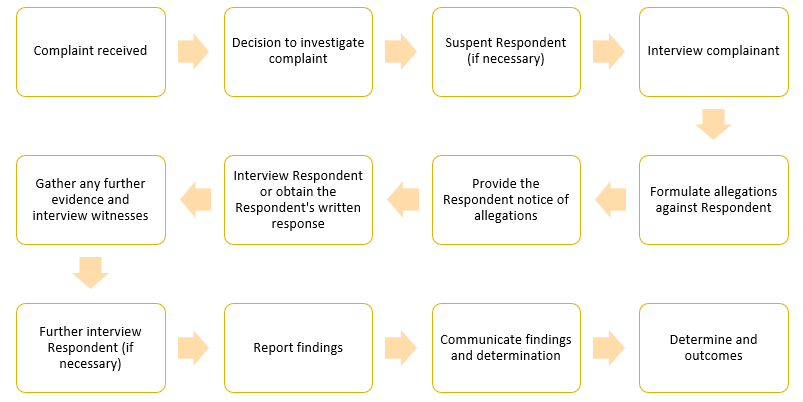
We have set out below a general map of a workplace investigation process:
The steps of the investigation process can be summarised as follows:
- Notifying the respondent: The Respondent should be notified that the employer has been notified of a complaint made against them. If appropriate, depending on the severity of the complaint, the employee should be notified that they are being suspended whilst an investigation into the complaint is being carried out.
- Interviewing the complainant: The complainant should be interviewed, and a record of the conversation should be put in writing for the complainant to review and approve.
- Allegations Notice: The allegations should be detailed and conveyed to the Respondent in full in writing.
- Opportunity to Respond: The Respondent must be given the opportunity to respond to the allegations and provide their own explanation of the events that occurred. The Respondent should clearly indicate whether they admit or deny the allegations.
- Further Information Gathering: If there is a dispute over facts, then statements from any witnesses and other relevant evidence should be gathered. Evidence that may be relevant includes:
- a statement from anyone who may have discussed the incident with the complainant after the events, including any family member, friend or co-worker. It is a matter for the complainant to advise whether any of these people should be interviewed and involved in the process.
- statements from any other witnesses who may have witnessed the incident;
- complaints or information provided by other employees about the behaviour of the Respondent;
- records kept by the complainant including any relevant emails, text messages or voice messages which may have been created before or after the incident which may be relevant. Unless the complainant uses a company phone, you cannot require the complainant to provide this but it should be requested;
- records kept by the Respondent including any relevant text messages or voice messages which may have been created before or after the incident which may be relevant. Unless the Respondent uses a company phone, you cannot require the Respondent to provide this but it should be requested.
- Investigation Report: Once a full investigation of the allegation has been carried out and evidence has been collected so far as is reasonably possible, a finding will need to be made as to whether the complaint has substance. A written report documenting the investigation process, the evidence, the finding and a recommended outcome/s should be prepared.
- Determination: On the basis of the information presented in the report, the employer will need to consider whether to implement the recommended outcome/s or decide on an alternative course of action.
- Outcome Notification: Once the employer has determined the outcome, the Respondent should be notified of the next steps in respect of their employment. Possible disciplinary action will depend upon the Respondent’s employment contract and any relevant workplace policies and can include:
- a commitment that the behaviour will stop; and/or
- professional counselling on appropriate behaviour; and/or
- re-training and/or training (group or individual); and/or
- verbal, written or final warning; and/or
- mediation; and/or
- direction to attend show cause -this may ultimately lead to termination of employment.
Managing an investigation can be overwhelming and it often helps to have an independent external firm carry out and manage the investigation. Contact Chamberlains HR for assistance with managing an investigation in your business.
Testimonials
Trusted by Hundreds of Clients
Have a question?
General inquiries