Despite the initially predicted financial apocalypse that COVID-19 was expected to bring, the Australian economy is currently flourishing in many indicators of economic health. From employment rates to property prices, Australia is experiencing figures that have not been seen for a long time, if ever. A side effect of such prosperity is the increased chance of recoverability. If you have been putting off filing claims, you may wish to reconsider and re-evaluate the recoverability of those claims before you give up on them.
Employment Rates
According to the Australian Bureau of Statistic’s seasonally adjusted unemployment data published for July 2021, the unemployment rate has fallen to just 4.6%, a decrease of 0.3% since June 2021 and the lowest Australian unemployment rate since December 2008. This also marks eight straight months of decline, and a 2.8% decrease since July 2020 (which was Australia’s highest unemployment rate since pre-2000).
Economists are attributing this fall in unemployment to both government stimulus payments during lockdown, which created a rebound effect at the end of the various state lockdowns, and the closure of borders which has limited the increase in the size of the labour force. Whilst the effects of the NSW lockdowns are yet to be fully felt by the Australian economy, it is predicted that the continuing financial support of the Australia Government may lead to a similar rebound effect, largely mitigating long term negative impacts to unemployment.
Property Prices
During the COVID-19 pandemic we have also witnessed incredible performance across the Australian property market, with a surge in house prices across all states. Six of Australia’s capital cities have recorded record median house prices for their third consecutive quarter, with the remaining two cities reaching their highest point in years.
Home Value Index August 2021
| Month | Quarter | Annual | Total Return | Median Value | |
| Sydney | 1.8% | 6.4% | 20.9% | 23.8%% | $1,039,514 |
| Melbourne | 1.2% | 4.0% | 13.1% | 16.0%% | $769,968 |
| Brisbane | 2.0% | 6.1% | 18.3% | 23.1% | $612,377 |
| Canberra | 2.2% | 7.3% | 22.5% | 26.8% | $816,644 |
| Adelaide | 1.9% | 5.3% | 17.9% | 22.7% | $522,180 |
| Hobart | 2.3% | 7.2% | 24.5% | 30.2% | $639,219 |
| Darwin | -0.1% | 2.4% | 22.0% | 29.0% | $486,248 |
| Combined Capital | 1.5% | 5.2% | 17.5% | 20.9% | $751,014 |
| Combined Regional | 1.6% | 5.4% | 21.6% | 27.1% | $493,925 |
| National | 1.5% | 5.2% | 18.4% | 22.1% | $666,514 |
Source: CoreLogic
The Australian property market has slowed down somewhat in recent months, coinciding with the prolonged lockdowns along the Australian east coast. Experts are saying however that, while lockdowns are having a negative impact on consumer sentiment, this is not yet translating to a fall in house price growth. Instead, this slowing of growth is being driven by affordability constraints.
Growth is being bolstered by the large disparity between supply and demand, but the slowdown is certainly noticeable and it is unclear whether, and for how long, prices will continue to maintain such heights.
Mortgage Interest Rates and Refinancing
Undoubtedly the huge demand seen in the property market is driven in no small part by the record low interest rates we’ve seen on offer in recent times. The Australia Reserve Bank cut the official cash rate to a record low 0.25 per cent in March last year, followed by an even lower 0.1 per cent in November. Off the backs of these rates, many lenders, including some big four banks, were offering three or four-year fixed rates below 2 per cent earlier this year, as well as the lowest variable interest rates on record.
Owner-occupier Variable Housing Rates
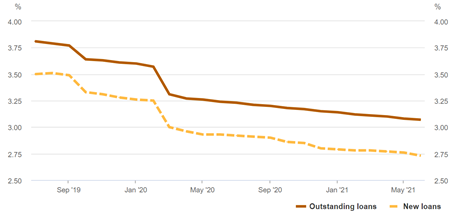
Source: APRA; RBA
These low interest rates have resulted in an all-time high in mortgage refinancing. Whilst historically, about 85% of borrowers stay on floating or variable rate mortgages, Commonwealth Bank was seeing up to 50% of people fixing their mortgage rates earlier this year.
We have already begun to see an increase in mortgage rates, and many economists are predicting they will continue to rise, which will likely see a subsequent drawback in the property market.
Practical Consideration in COVID-19 Litigation
Often in court proceedings, parties are required to personally serve documents on their opponents or even third parties. Personal service means that the documents must be handed to the recipient personally rather than by post or email. One might think that social distancing requirements would prevent or inhibit personal service during lockdown, but in reality process servers are still operating more or less as normal.
One factor to note however is that, in our experience, serving people at their business addresses has become much more difficult as a result of lockdowns and stay at home orders. As such, we recommend trying to locate and serve persons at their residential address to avoid wasting money on unsuccessful service attempts.
Limitation Period
Almost all civil claims are subject to a limitation period, a period of time prescribed by statute within which a legal action can be brought or a right enforced. With some exceptions, a claim cannot be commenced outside the limitation period, making it one of the most important things to keep in mind once you become aware of a potential cause of action.
The length of a limitation period generally varies between 1 to 12 years, and the time from which it begins to run will also depend on the type and factual circumstances of the claim. As such, it is important to get legal advice as soon as possible to avoid running out of time. Even if you are sure that a claim is not commercial to run, we recommend getting advice on the limitation period so you are aware of how long you have to potentially revisit the claim in the future.
Conclusion
So what does this all mean for potential litigants?
A huge factor in deciding whether to commence court proceedings is the prospects of recovery, or how likely your opponent will be able to pay a judgment if you are successful. If opponents can’t afford to pay the judgment, this may result in them entering bankruptcy or insolvency, ultimately decreasing how much you might expect to recover. Prospects of recovery also factors in how likely your opponent will be to enter an early settlement agreement, and how much such a settlement will be worth. Such considerations are vital when commencing a claim to ensure you don’t pay out more in legal fees than you get back in the end.
A silver lining to the pandemic we find ourselves in is the pervasive increase in prospects of recovery. The property market boom, coupled with high likelihood of defendants being employed to some degree, increase the chances that defendants will have sufficient assets to satisfy a judgment or settle a claim early. These may even be the key factors in whether a matter is commercial to pursue or not. Indeed, even claims that there were once considered uncommercial to run may now be worth pursuing given how rapid the growth in the property market has been recently.
Finally, due to expiring limitation periods, the ongoing lockdowns and the inherent uncertainty in economic forecasting, it is important to investigate the prospects of your claim as soon as possible to capitalise on these highs. If you have any questions or concerns please contact Chamberlains and talk to one of our insolvency & restructuring lawyers today.
What is a Caveat?
A Caveat is a legal dealing registered over land, effectively an encumbrance over the land to limit certain transactions being done with the land and to warn others as to your potential interest in the land. A person who lodges a Caveat over a property is called a ‘caveator’.
What does a Caveat do?
A Caveat will stop most (but not all) dealings with the title to a property. A caveat will stop the registrations of further mortgages and also limit the sale of the property without court order.
Can I lodge my own caveat?
You can lodge your own caveat, however, lodging a caveat without expert legal advice can be risky, as you can become liable for the land owner’s damages and other costs if you improperly lodge a caveat. We recommend contacting Chamberlains expert Property Team.
What do I need to lodge a caveat?
For example, in most Australian jurisdictions you require:
- Your name and address, including an address where notices can be served;
- The property title details, name and address of the registered proprietor or owner of the property;
- Details of your legal or equitable claim or interest in the land and reference details;
- A statutory declaration; and
- Proper execution of the caveat form by yourself, a lawyer or approved agent.
What are the risks of lodging a caveat?
- Lodging a Caveat when you do not have a sufficient rights can leave you liable for damages. Those damages could be substantial if your Caveat gets in the way of a transaction for the owner. Before lodging a Caveat, you should obtain advice as to whether or not you have sufficient grounds to lodge the Caveat.
- You can’t lodge a second Caveat on the same grounds. Consequently, if your Caveat lapses after a period of time, you can’t lodge a new Caveat on the same grounds.
How do I remove a caveat?
In NSW, you can either:
- If you are an owner of land, you can lodge a lapsing notice with the land titles office and put the pressure bank on the caveator to go to Court to justify why it remain on title.
- If you are a caveator, you can lodge forms to remove the title quite simply.
- The Court is also able to assist parties when there is a dispute.
Whenever registrations on title are concerned and there is a significant risk of Court involvement, I is vital you obtain proper legal advice. Though caveats can be an excellent tool to assist parties in securing their interests and even often getting paid, they are a deceptively complex area of law and proper legal advice is a must.
If you have any questions or concerns please contact Chamberlains and talk to one of our insolvency lawyers today.
Background
Under section 459E of the Corporations Act 2001 (the Act), a creditor may issue a statutory demand to a debtor company.
Once served, a debtor company only has 21 days to either pay the debt in the statutory demand or make an application to the court to have the demand set aside.
If the debtor does neither, it is presumed to be insolvent and the creditor may make an application to wind the debtor company up.
Usual basis for setting aside a statutory demand
An application to set aside a statutory demand is normally made on the basis set out in section 459H of the Act that either:
- There is a genuine dispute about the existence or amount of the debt; or
- There is an offsetting claim.
The task of establishing a genuine dispute is considered not to be difficult or demanding.
Statutory demands based on judgment debts
Things are less straightforward if the statutory demand is based on a judgment debt and there is a dispute about the debt giving rise to the judgment.
This issue was recently addressed in Chapel of Angels Pty Ltd v Hennessy [2021] FCA 875 (02 August 2021).
In that case, judgment was obtained against a debtor company and a statutory demand was served based on that judgment.
The judgment debtor applied to set aside the statutory demand on the basis that there was a genuine dispute about the debt.
The court dismissed the application and awarded indemnity costs.
The court followed prior cases and found that it was not possible for an applicant to apply to set aside a statutory demand based on a claimed genuine dispute if the statutory demand is based on a judgment, even a default judgment.
There is still hope if a statutory demand is based on a judgment
However, if the judgment is the subject of an appeal or an application to set the judgment aside, an applicant may still apply to have the statutory demand for “some other reason” under section 459J(I)(b) of the Act.
Such an application was considered In the matter of AAP Investments (Aust) Pty Ltd [2015] NSWSC 1049 (04 May 2015). In that case, the underlying default judgment on which the statutory demand was based had been set aside. Accordingly, the court held that there was “some other reason” why the statutory demand should be set aside under section 459J(I)(b).
If you have any questions or concerns please contact Chamberlains and talk to our dispute resolution team today.
Many parents have faced the situation where their child has suffered an injury at childcare or school. Kids can be unpredictable and bumps, falls, knocks and injuries generally are common. We expect that this will happen from time to time, but it’s a different story if the injuries occur because of the negligence of others.
Duty of Care
Schools owe a duty of care to their students to take care of the wellbeing and safety and to avoid students being injured.
For the most part schools do a fantastic job of providing a reasonable standard of care. However, if mistakes happen and the school does not uphold its duty and a child is injured, the school may be liable to pay compensation to the student.
When will a school be found liable?
In order to make a claim you must prove that the school did not uphold their duty of care and that as a result your child suffered an injury.
Generally a school won’t be found negligent if a child is injured in the normal course of playing. But a school may be liable where the injury has occurred as a result of negligence, such as failing to properly supervise the children, or if there are unsafe buildings or equipment or where a school doesn’t take adequate steps to protect the students.
For example, a NSW school boy was awarded compensation when he fell down an uncovered drain in the playground and suffered injuries to his arm and a psychological condition.
What about bullying at school?
Bullying is a topical issue, and advances in technology and social media means bullying can be relentless and affect children in and out of school. This can be hard to manage, but what about cases where a child was bullied repeatedly and complaints to the school went unheeded?
Generally a school may be liable for physical or psychological injuries where a school knew or should have known about the bullying and failed to take action within a reasonable timeframe to address the bullying. The school needs to take measures such as implementing a bullying policy, acting upon complaints of bullying and supervising, disciplining and counselling the perpetrators.
If your child has suffered injury at school, whether physical or psychological, please contact our injury compensation team to arrange a no-obligation appointment.
The New South Wales Supreme Court has ruled that the school of a boy who suffered a head knock while playing a game similar to touch football in PE class is not liable for his injuries.[1] The care taken by the PE teacher while supervising the game was found to be reasonable, and no duty of care was breached.
Facts
The plaintiff was playing a game similar to touch football in the top graded male PE class at school when he suffered a head clash with another student while jumping for a high ball that the teacher kicked to commence the game. The plaintiff was a 15-year-old skilled rugby league player.
The PE teacher and school nurse both initially thought the injury was minor and allowed the plaintiff to get the bus home as his mother could not pick him up. When attempting to get on the bus, the plaintiff slipped and fell. The bus driver did not allow him back on. The plaintiff attempted to walk to his friends’ house but was disorientated and went to the beach. Plaintiff was eventually picked up by his mother after being found by friends, who took him to the hospital.
Months after, plaintiff began having seizures that have continued to date.
Claim
The plaintiff claimed the PE teacher was negligent in allowing the game to be played, and that the first aid of the PE teacher and school nurse was negligent due to failing to provide adequate care and monitoring of an injured/concussed person.
Decision
The court agreed with the Defendant’s liability expert that the game was conducted safely by the PE teacher, and that the game fit well into their syllabus. The court found the PE teacher and nurse were not negligent in their care of the plaintiff, as the plaintiff was not seen to be knocked out, and the nurse made an attempt to contact the mother but was told by the plaintiff she wouldn’t be able to be reached.
The Court found the defendant did not breach their duty of care to the plaintiff. The Court cited Trustees of the Roman Catholic Archdiocese of Sydney v Kondrajian [2001] NSWCA 308, “A school is not an insurer of its pupils.” Just because the plaintiff was injured under their care, does not mean they are liable. The Court found that the risk of injury was a possibility, but the supervision was appropriate.
The Court ruled in favour of the defendant and ordered the plaintiff to pay the defendant’s costs.
[1] Mattock v State of New South Wales (New South Wales Department of Education) (No 2) [2021] NSWSC 1045
A common question for crypto investors and traders in whether they can account for different parcels of crypto under the first-in first-out (FIFO) of last-in last-out (LIFO) methods – or if they can choose. Each can give wildly different tax outcomes and using the wrong method can expose you to risk.
This article will walk through the current ATO guidance on this.
For Investors – some choices available
The ATO position on disposals of identical assets (shares, units, perhaps also crypto) is relatively clear.
In Taxation Determination TD 33, the primary position is that where a disposal of shares occurs and you can distinguish which parcel is which such as share certificate numbers, different classes and others, the cost base and date of purchase for CGT purposes are known.
However, where the position is not known, TD 33 allows for a taxpayer to decide themselves which parcel of shares are being disposed of. The ATO accepts the FIFO basis as a reasonable method, though there is no restriction on reasonable methods – LIFO is also acceptable, as is highest-in first-out.
An average is not acceptable unless the shares are in the same company, acquired on the same day and have identical rights.
For traders – limited choices
Where there is specific items of trading stock being transacted, the actual cost of each parcel is preferred. Often this is not available, or multiple parcels have been purchased and unpicking which is being sold is not practical or accurate.
The ATO accepts that FIFO is the only available method for trading stock where specifically identifying the particular parcel is not possible.
This is outlined in in Taxation Ruling IT 2350 and Taxation Ruling TR 96/4. An average cost method is not acceptable per Taxation Ruling IT 2289.
Does this apply to crypto assets?
There is no specific guidance on whether the ATO will accept the above for crypto. There are also no private rulings on the topic yet. In our discussions with the ATO cryptocurrency specialists it was agreed that this treatment will likely apply. Investors and traders should watch this space for specific guidance from the ATO on this topic.
Any tax controversy with crypto assets can be handled by our Tax and crypto specialists who have a strong relationship with the ATO. The team is also clarifying many crypto tax issues with the ATO in the coming months.
If you have concerns or questions about Cryptocurrency Law or/and Tax Planning, contact Chamberlains Law Firm today.
On 28 August 2021, after extensive consultation with the medical, insurance and business sectors, the Minister for Health and Aged Care, Greg Hunt, announced the No Fault COVID-19 Indemnity Scheme. The Scheme offers protection to Australians that have serious adverse effects as a result of receiving a Therapeutic Goods Administration (TGA) approved COVID-19 vaccine.
From September 6, Australians who suffer loss of income and injury as a result of their COVID-19 vaccine will be able to lodge their intent to claim damages on the COVID-19 vaccine claims scheme webpage.
The scheme, which will be backdated to February 2021, will cover the costs of injuries above $5,000 that are proven to be caused by a COVID-19 vaccination. The claims will be assessed by independent experts, and compensation paid based on the recommendations.
The scheme will be fully funded by the Commonwealth and is designed to assist the small number of people who have had moderate to significant adverse reaction to a COVID-19 vaccine without a costly and complex court process. Australians who are experiencing such reactions are encouraged to report it to their doctor who can provide the information to the TGA to include in their reporting.
Key takeaways and compliance requirements:
Construction sites across the ACT are due to re-open in full from Friday 10 September 2021. However, there will be a number of new obligations for all builders and contractors undertaking residential construction work.
The ACT Government has provided a comprehensive list of requirements for all construction industry participants to adhere to when getting back to site, which can be accessed here. The key takeaways are:
- Check in CBR App:
Every building site must have a QR code available for anyone entering the site to check in via the Check in CBR App. This applies regardless of how long someone will remain on site, however will not be required for repair or maintenance work at a private residence when that work will take under one day. - Appointment of COVID-safe marshal:
The purpose of an on-site marshal is to manage compliance, and to act as a liaison should the site be exposed to COVID-19. Industry bodies suggest this should be the site supervisor, or someone similar with knowledge of all employees and contractors on site.
COVID-safe marshals are required to undertake infection control training prior to their appointment, which is provided by the federal government and can be accessed here. Any prospective site marshals should ensure this training is completed prior to Friday 10 September 2021. - Adequate supplies of PPE and safety equipment:
This includes hand sanitiser, face masks and any other equipment required to ensure compliance with the government’s compliance requirements.
At this stage, display homes will remain closed and categorised as non-essential retail.
The construction industry shutdown has affected the livelihoods and wellbeing of many businesses and individuals. News of the pending reopening in a safe and coordinated fashion is welcoming for all industry participants.
We’re here to help
We at Chamberlains appreciate the difficulties builders, contractors and homeowners alike have been facing in recent times. Should you or your business need some assistance to navigate any legal issues which have arisen during these unprecedent times, please do not hesitate to contact our building and construction law team.
The New South Wales Supreme Court has recently ordered that an adult child be paid a lump sum from the estate of the deceased despite not having contact for 28 years in the case of Flanagan v Fisher [2021] NSWSC 598.
Facts
The Plaintiff, Andrew Flanagan made an application to the Supreme Court for provision from the estate of the Late Ronald Flanagan, his legal father.
Wilma and Ronald Flanagan became the legal guardians of the plaintiff when he was 5 months old. They separated then later divorced when the Plaintiff was 13 years of age. In the 28 years between the separation of Wilma and Ronald, the Plaintiff resided with Wilma and his relationship with Ronald diminished until it was non-existent. The Plaintiff tried to contact Ronald in his later years but no response from the deceased was made.
Ronald made a will dated 22 May 2017 in which he left his estate to the RSPCA and noted that he had intentionally excluded the Plaintiff and did not want him to receive any provision from his estate. Ronald died in 2019.
Decision
In relation to the issue of estrangement the court accepted the Plaintiff’s submissions that the estrangement between the Plaintiff and the deceased rests with the deceased due to his indifference to the Plaintiff in the years following his separation from Wilma.
In relation to the Plaintiff’s circumstances and needs the court noted that the Plaintiff did not have any particular financial or other need with would warrant provision of half of the estate. The plaintiff had demonstrated that he had worked hard to overcome a very difficult circumstances and had maintained good employment and had demonstrated responsibility in the management of his personal, health and financial affairs.
In conclusion the Court held that the Plaintiff did have a moral claim for provision from the estate and in balancing all matters provision was made for the Plaintiff in the sum of $160,000.00.
At Chamberlains, our wills and estate planning lawyers can provide assistance with both defending and contesting Wills. We can guide you through the entire process. From advising on your prospects, lodging or defending a claim, and seeking Benjamin Orders from the Court, we can get the job done.
As part of its progression to 100% eConveyancing, the New South Wales Government has recently announced new changes to the land titles system, which will take effect from 11 October 2021.
Significantly, the Real Property Amendment (Certificates of Title) Act 2021 makes several changes to legislation, which allows for the cancellation of Certificates of Title (CTs) and changes the Right of Control to Deal (CoRD) framework, as well as the electronic lodgement of all land dealings.
This means that from 11 October 2021, existing CTs will be cancelled. CTs will no longer be issued to those who pay off their mortgage, purchase a property without a mortgage or for new parcels of land created upon registration of a plan of subdivision. The changes also extend to Authorised Deposit-Taking Institutions, such as banks, as they will not be issued with CoRD, which is the electronic equivalent of a CT.
In its move away from CTs and CoRD, the NSW Land Registry Services will issue an Information Notice for all land dealings. The Information Notice will include the title details, the dealing(s) that were registered, including their registration number(s), the subscriber’s preference, and the registration date. The registration of these dealings will be updated on the Torrens Title Register.
The Torrens Title Register that NSW Land Registry Services maintain will continue to be the single source of truth regarding property ownership. A Title Search may be obtained from NSW Land Registry Services, which will provide the most accurate and up to date title information regarding the property.
There is nothing that you must do prior to 11 October 2021. After this date, the CTs will be cancelled and no longer be a legal document.
Get in touch with our conveyancing specialist team for your legal questions.